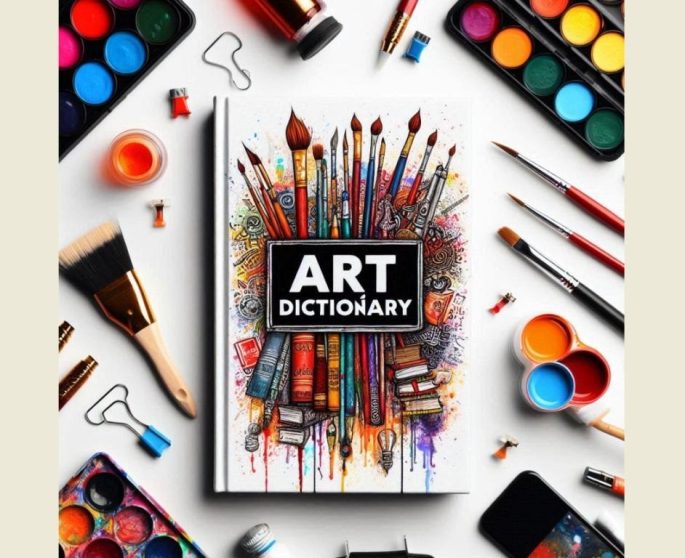
ART TERMS-ART DICTIONARY
A
- Academy: The place where Plato taught his students in ancient Greek culture; a general term for higher education institutions providing fine arts education.
- Academic: Works conducted within the discipline and rules of academic education.
- Affiche: A poster used to inform the public about a thought, product, or event by being pasted or hung on walls.
- Altamira: A cave in northern Spain famous for its prehistoric wall paintings and engravings.
- Analysis: The detailed examination of any object, subject, or situation broken down into parts and sections.
- Antique: A term used for art or architectural references from ancient Greek and Roman periods.
- Art Nouveau: An ornamental style characterized by flowing lines and floral motifs.
- Armature: Reinforcement placed inside a material to make it more durable and rigid.
- ASA (American Standards Association): Method for rating light-sensitive materials.
- Acrylic: A fast-drying paint made of pigment suspended in acrylic polymer emulsion, allowing for vibrant colors and a variety of styles.
B
- Balance: The visual weight effects created by elements in a composition and their relationships to each other within the artwork.
- Baroque: A style characterized by dramatic expression and grandeur in art and architecture.
- Bauhaus: An art school founded in the 1940s focusing on architecture.
- Bust: A type of sculpture representing the upper part of a human figure.
- Bronze: A metal alloy made primarily of copper and tin, often used in sculpture and decorative arts.
C
- Calligraphy: The art of beautiful handwriting developed around Arabic letters.
- Ceramics: The art of producing architectural items from clay that can be shaped when mixed with water and become hard after firing.
- Clay: Particles smaller than 0.005 mm; it is malleable when hydrated aluminum sulfate is present.
- Collage: An artistic composition made of various materials glued together to create a new piece.
- Cubism: Developed by Pablo Picasso and Georges Braque in the early 20th century, this movement breaks subjects into geometric shapes and reassembles them in abstract forms.
D
- Dada: An international movement influential in literature, theater, and visual arts.
- Diaphragm: The system on a camera lens that controls how much light reaches the film; it determines the intensity of light falling on the film during exposure.
- Drawing: Expressing an image through lines.
- Dominant Color: The most striking color in an artwork that captures visual attention.
E
- Ebru: A traditional decorative art technique involving floating paints on water to create patterns transferred onto paper.
- Expressionism: An artistic movement emphasizing emotional experience over physical reality.
- Engraving: A printing technique made by incising designs onto metal plates; can also refer to woodblock printing techniques.
F
- Fantasy Art: Art that disregards reality by referencing dreams, supernatural elements, or fictional narratives.
- Fauvism: An expressive painting style characterized by bold colors and brushwork.
- Fresco: A mural painting technique applied on wet plaster with pigments mixed with water.
G
- Glyptic: Refers to carving techniques often used in stonework; means “to carve out.”
- Golden Ratio: A mathematical ratio commonly found in nature and art that is aesthetically pleasing.
- Graphic Arts: Important branches of plastic arts including painting, sculpture, architecture, and decorative arts.
H
- Hue: Refers to different wavelengths represented as colors like red, yellow, green, blue.
- Happening: Artistic actions driven by spontaneous impulses performed collectively without prior design.
I
- Idealism: Creating works based on high thoughts aimed at achieving ideal standards; this concept is widely explored in art and philosophy.
- Icon: Images representing Jesus Christ, Virgin Mary, or saints within Orthodox church art.
- Impressionism: A 19th-century art movement characterized by small, visible brushstrokes and an emphasis on capturing light and its changing qualities.
J
- Genre: Representation of everyday life examples through painting.
K
- Kaolin: High-quality white clay used for porcelain production.
- Kashi: Term used for ceramics until the 18th century among Ottomans.
L
- Lithography: A stone printing technique where natural stones are used as printing plates.
- Lascaux: Cave near Montignac in France known for its significant prehistoric wall paintings.
M
- Model: An object chosen to be depicted in an artistic work.
- Mimesis: Refers to imitation of visible things; expressed as “reflection” or “emulation.”
- Minimalism: A movement that emerged in the late 1950s, characterized by simplicity and a focus on the essentials of art.
- Mixed Media: The use of multiple artistic mediums or materials in a single artwork.
N
- Naive Art: Artworks created by untrained artists.
- Still Life: Paintings depicting lifeless objects arranged artistically.
- Narrative Art: Artwork that tells a story or conveys a message through its imagery.
O
- Oil Paint: A type of paint made by mixing pigments with oils, notably linseed oil, which allows for a rich texture and depth of color.
- Opposition: A principle in art involving contrasting elements used to create visual interest and tension.
P
- Palette: A board or surface on which an artist mixes colors before applying them to canvas.
- Perspective: The technique used in drawing and painting to create the illusion of depth and space on a flat surface.
- Photography: An image created by capturing light through a lens system onto a photosensitive surface.
- Pop Art: An art movement that emerged in the 1950s and draws inspiration from popular culture and mass media, often using bold colors and imagery.
Q
- Quilling: An art form that involves creating decorative designs by rolling and twisting strips of paper.
- Quality: In art, it refers to the degree of excellence or characteristics that render artwork valuable or admirable.
R
- Relief: Sculptures designed on a flat surface.
- Realism: An artistic movement that focuses on depicting subjects as they appear in everyday life, without embellishment or abstraction.
- Renaissance: A period of revival in art and culture in Europe, marked by a renewed interest in classical learning and humanism.
S
- Sculpture: Three-dimensional artistic objects created by carving, modeling, or casting various materials.
- Style: The distinct features and characteristics that define the manner in which an artwork is created.
- Surrealism: An art movement that aims to challenge perceived reality by exploring the unconscious mind, dreams, and irrational imagery.
T
- Texture: The structural quality of an object that encompasses its entire representation; visible and tactile effects.
- Transparency: The quality of a material that allows light to pass through, which can create effects in painting and other mediums.
- Triptych: An artwork made up of three panels that are typically hinged together.
U
- Uncanny: In art, refers to something that is strangely familiar, yet foreign at the same time, often evoking a sense of discomfort.
- Urban Art: Artwork created in urban environments, often associated with street art and graffiti.
V
- Varnish: A clear, protective finish applied to the surface of paintings, increasing durability and enhancing colors.
- Visual Arts: A broad category that encompasses all art forms visually perceived, including painting, sculpture, photography, and more.
W
- Watercolor: A painting method that uses pigments mixed with water and is characterized by its translucency and fluidity.
- Wash: A technique in painting where a large area is covered with a diluted ink or paint, often used to create backgrounds or soft shadows.
X
- Xylography: The art of engraving on wood and printing from the wooden blocks, a technique used historically for illustrations.
Y
- Yellowism: An artistic movement that considers yellow as the primary form of artistic expression and challenges conventional concepts of art.
Z
- Zentangle: A method of creating images by drawing structured patterns, often used as a form of art therapy.