
Pablo Picasso Biography – Picasso Life and Art Works
Pablo Picasso was born on October 25, 1881, in a large white house in Malaga, southern Spain, at 11:15 p.m. Her birth was very difficult, and when she could not breathe for a long time after she was born, her uncle, Dr. Don Salvador, blew air through his nose and started breathing reflexes.
His father, Don Jose Ruiz, who came from a well-known Andalusian family, was a smart, cultured, beautiful-speaking, but a bit lazy painter.
He taught painting at art institutes. He specialised in dining room decoration. His favorite motifs were feathers, leaves, parrots, lilacs and especially pigeons. Pablo grew up among the pigeons his father fed him to use as a model. When he was nine years old, Don Jose saw that Pablo had completed a painting that he had started perfectly, so he decided to raise him as a painter by gifting his palette and brush to his son. In childhood, he had as much passion for corrida (bullfighting) as he did with his father every year.
After Don Jose started teaching painting at an art school in La Corugna, northern Spain, in 1891, Pablo learned all the painting techniques there, but by the age of 11 he had difficulty comprehending the most basic knowledge in reading, writing and computation. He passed the diploma exam with the help of teachers. Since then, portraits of his close relatives have reached a great leap point in his artistic life and he has painted as beautifully as Rafael, as he calls himself. After that, painting became a way of life for him.
In the early summer of 1895, they returned to Malaga as a family for a holiday, stopping in Madrid. Don Jose takes his son to the Prado Museum. Pablo watches with deep surprise the works of great painters such as Velasquez, Zurbaran, Goya, El Greco. What he sees in the museum will play a crucial role in developing Pablo’s painting skills.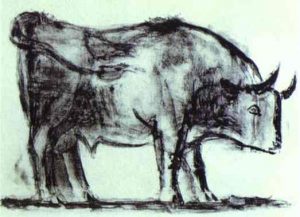
When the school season arrives, they head to Barcelona, which is also in the north: his father was assigned to the School of Fine Arts. In this Catalan-speaking city, French influence prevails and culture and art are very developed. Pablo loves Barcelona, a rich, fertile, vibrant city.
At the age of fourteen, he was accepted to La Lonja, which had strict traditions thanks to his talents and his father’s isr, mainly teaching ancient art. At the Academy, he befriends a painter named Manuel Pallares. This friendship will earn him much more than the school’s laborious lessons.
In the fall of 1897, he went to Madrid alone (to get away from his father, who fell a little too much on him). He enters the competition of the Royal Academy. It’s as astonishing a feat as barcelona. Within a day, he completed all the courses with extraordinary success. He spends the winter alone in Madrid, penniless and hungry. He fully immates himself in painting, where he tries to find a unique style by recognizing almost all art movements.
When he fell ill in the spring of 1898, he returned to Barcelona. His painter friend Manuel Pallares invites him to his village (Horta de San Juan). This is really Pablo’s first encounter with country life. Even years later, he’ll say, “Whatever I know, I learned it all in pallares” village.
In the spring of 1899, he met the young poet Jaime Sabartes in Barcelona, Spain, and over the years Sabartes would be his most loyal friend, life partner and sidekick. Pablo continued his coffee for a while with Els Quatre Gats (named after the famous cabaret of Montmartre, Montmartre, Le Chat Noir) where he met young musicians, poets and rebellious politicians and opened his first exhibition on February 1, 1900: He was pinned to the walls of the thin long hall with about 150 pattern needles.
In October 1900, Pablo made his way to Paris with his new friend Carlos Casagemas to escape. In those years, Paris became famous as the capital of painting. Although Picasso doesn’t speak a word of French, like many other painters, cheap food, entertainment and lively discussions are centered on Montmartre. In a few months, he visits all the museums, especially the Louvre. His impressionists are Degas, Toulouse Lautrec, Van Gogh and Gauguin. He admires Phoenicic and Egyptian art. In the middle of winter, his friend Casagemas commits suicide by putting a single bullet in his head because of the pain of love. In deep grief, he leaves his friend’s body in Barcelona and returns to Paris in the spring of 1901. This time, Clichy gets a small room at 130. In his paintings here, the “Blue Period” began. Despite the simple sensuality of the subjects, El Greco’s paintings show a change in formality: human figures have elongated bodies, hands, feet and fingers, and all shades of blue have been studied predominantly. Skeletal bones are very pronounced. During this period, he began to use picasso, his mother’s name, in his signature.
Meanwhile, rodin, the greatest carving of the age, saw his works, which added a new dimension to his life and he started plastic work for the first time.
In June, art dealer Ambroise Vollard exhibited Picasso’s canvases in his gallery. Meanwhile, he meets the young poet and art critic Max Jacob. He admires his accuracy, the authenticity of his judgments, his brilliant enthusiasm. During the day, he and his fellow Spanish painters listen to poetry in Max’s small, cold hotel room, in the evenings he hangs out in Montmartre’s cabarets, occasionally going to the Moulin Rouge if he can find tickets.
He shuttled between Barcelona and Paris many times until 1904. He loves both cities with great love and cannot choose one over the other. Without money, he moves into his friend Max Jacob’s room. They have one bed and one top hat. They use them jointly. Max sleeps at night — when Picasso works — and during the day, when he goes to work, the bed stays with Picasso. Despite the hunger and misery, he is happy with his friends.
In 1904, on a stormy, rainy evening, he met Fernande Olivier at the entrance to the workshop (Bateau-Lavoir), where he had just moved in, and fell in love with her. Shortly afterwards, the girl settles in the workshop. Picasso paints thousands of his paintings. But they have a hard time because of lack of money. They can’t even buy coal to keep warm. Picasso paints at night in the light of a gas lamp dangling over his head, candlelight in his left hand if he can’t buy gas.
Picasso always needed solitude to work, but he also failed to live without friends. Most of his friends are poets because he likes poetry so much. In the fall of 1905, he met guillaume Apollinaire, an exuberant poet who was half Italian, half Polish. During these years, Picasso began the “Pink Period” in his paintings, probably under the influence of Fernande. He also paints about the Medrano circus, where he meets his friends backstage once a week. During this period, he is more interested in “nude” than ever before. It is now predominantly pink in its paintings. The figures have become more beautiful and well-groomed.
Sculptor Paco Durio and Manolo Hugue hit the road to arm and sell paintings by the painter Canals and the poet Max Jacob Picasso. Because Picasso refuses to show his paintings to the public, he gets tired of people asking him stupid questions in order to understand his work. On the other hand, amateur collectors who were able to buy paintings became interested in Picasso. Among them, Leo and Gertrud Stein are so fascinated by their paintings that they buy eight hundred francs of paintings in one fell swoop. In 1906, an unexpected event occurred: Gallery owner Ambroise Vollard forked out 2,000 francs for some of her pink-era canvases. In early June, on the advice of the son of Greek politician Venizelos, he and Fernande went on holiday to the town of Gosol, on the outskirts of the Spanish Pyrenees, near Barcelona. Gosol would be the starting point for Picasso in a new era. He sets out to paint with a stronger desire than ever before. It again chooses people, landscapes and houses as its subject. And fernande’s serene beauty. They return to Paris together at the end of the summer.
In late 1906, Picasso became known not only in painting and pattern, but also in sculpture and engraving.
In July 1907, he was deeply influenced by african masks and sculptures he saw at the Museum of Anthropology in the Trocadero. The clarity of the relationship between mankind and nature, the direct expression of feelings such as fear, violence, joy, confuses him. The formats are extremely simple and geometric. From now on, the inspiration for his transformation has been revealed. The first painting he produced during this period was a portrait of Gertrude Stein.
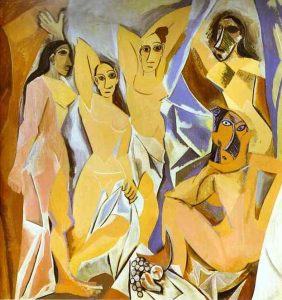
At the end of 1907, Picasso closed his workshop to finish the giant painting he started a few months earlier. When he finally opens the door, his friends are stunned to see the picture. The painting is against all the rules that have been in place since the Renaissance. Matisse, the great painter is angry! Braque, a close friend of Pablo’s, says, “It’s like you want to make us eat and drink kerosene!” Even Apollinaire, who has always depended on Picasso as his bellowsman, criticizes his friend. Moreover, a well-known art critic who came to the workshop with him politely advises him to give himself to the caricature. Only one person supports him: the German collector Kahnweiler, who will later become the greatest modern painting dealer of the 20th century. The scandalous painting was originally called “Le Bordel [brothel]”. It will be the starting point of “Cubism”, one of the greatest art movements of the 20th century. A few years later, the painting is called “Girls with Avignon”.
The scandals and criticisms of the painting do not affect Picasso’s friendships. He started working more regularly. He spends all day painting and has fun at night. Instead of Montmartre, Montparnasse now hangs out at a brewery called “La Closerie.” Because here, in addition to a new literary community, painters, sculptors and musicians hold weekly fiery meetings.
In the fall of 1908, his friend Braque exhibited his first cubist paintings. Picasso also began painting figures and landscapes of simple geometric shapes with dull green-brown tones like his. These two friends have been the main players of cubism for many years. These years are considered picasso’s most creative period.
In July 1909, fernande and I went to Horta de San Juan, the village of pallares. There has been no change in the village in the past decade, but this time the landscapes it makes are completely different. It freely interprets the existing landscape with lean geometric shapes instead of passing it on the canvas as it is, i.e. copying it. Cezanne, as he calls it, processes nature with cylinders, spheres and cones.
They return from Horta with numerous canvases. Vollard the merchant immediately exhibits them in his gallery. Although the public generally does not like this new cubist trend, most of the paintings are sold. The number of Picasso fans increased, including Russians, Germans and Americans. Picasso survived the misery he was in until three years ago.
In September 1909, fernande and I moved into the large, bright workshop-house at 11 Clichy Boulevard. The windows of the house overlook a meadow as big as the ocean. Their way of life and their environment have changed radically. But despite this, Picasso fills the house with trinkets. Guitars, overly shaped bottles, different colored glasses, tapestries, African masks and paintings by painters (Matisse, Rousseau, Cezanne) stand scattered through the house. Picasso, as he always says, does not like subtle appreciation and harmony.
In the summer of 1910, Picasso and Fernande stayed with their fellow poets and artists in Ceret, an extremely charming town on the outskirts of the Pyrenees on the Spanish-French border. Then they come here for three years in a row. Pablo and Fernande are separated on their last arrival.
Picasso Fernande then begins flirting with his friend Eva (real name Marcelle Humbert). They’ll go with him to the South of France. On the way back, they rent a villa near Avignon. Braque and his wife settle close to them. Here the two painters give the richest products of cubism. Picasso has regained his extraordinary desire to work. In his paintings, he also uses words such as “Ma Jolie “My Beauty”) (a song title that was much loved at the time). Meanwhile, braque and I are developing the collage technique for the first time; they paste the newspapers and wallpapers they find into their pictures to create a depth dimension.
In the fall of 1912, Picasso and Eva moved to Montparnasse. Le Dome, La Closerie des Lilas and La Couple are famous coffee shops and friends with artists from all over the world.
On August 1, 1914, when the war between France and Germany began, his friends Braque, Apollinaire, Leger and Derain were conscripted. Pablo’s Not armed because he’s Spanish. The war broke out just as cubism gained great momentum. The only friend left with him, Max Jacob, is confined to the convent. Eva, on the other hand, is sick, gradually weakened, and dies on February 14, 1915, after suffering terrible pain.
Alone in Paris, Picasso meets Jean Cocteau, who admires cubing and his paintings. With him, the famous Russian choreographer Sergei Diaghilev travelled to Rome to draw décor and costumes in a new play by the world-famous ballet group. In his new project, Diaghilev wishes modern art masters to participate in dance. On 17 May 1917, the ballet “Surrealist” Parade was performed in Paris, France. A few months later, Diaghilev takes the group to Barcelona. Picasso accompanies them. One of the dancers fell in love with Olga Kokhlova, the daughter of a Russian general. It paints an extraordinarily beautiful picture of her.They married on July 12, 1918, and welcomed new friends by holding a house in an upscale parisian neighborhood. Picasso now has little contact with his old friends. Apollinaire catches a severe flu, dies. Picasso may also change his style of painting around this time, perhaps under the influence of his wife Olga. He makes a complete comeback and begins the classic painting. Critics accuse him of betraying cubbics.
In February 1921, their first child, Paulo, was born. Picasso admires his son. He loves his wife, too. However, this new urban person is not happy with life. It continues to paint classically until 1925, but these paintings have another figurative content that also uses the gains of cubism. On this date, Picasso ends his classical era with a painting that stunned everyone: “Dance”. The new picture is dominated by unprecedented violence. The dancers’ arms and legs are pulled, and the lines on their faces seem to be swayed all over. Creepy faces, hair like a vest, fingers like nails. It’s probably just a blast because of his marriage, which didn’t go well anymore. On the other hand, it has entered the gravitational pull of the increasingly widespread “Surrealism” movement since 1924: All dreams under the consciousness are depicted in a beauty that will create mayhem.
Marie-Therese goes shopping at the gallery “Lafayette” after the subway on a cold winter’s day in January 1927. He goes right up to him and says, “I’m Picasso, we’re going to do great things together.” She falls madly in love with her serene beauty. Marie-Therese, a painter whose name she didn’t even know until then, paints thousands of pictures of her pretty face. Nudity is at the forefront of these pictures, but this passionate relationship will remain hidden for years to come.
In 1931, he bought a beautiful mansion near Paris. With the excitement of recapturing happiness and the encouragement of his friends Louis Fort and Gonzales, he sets up an engraving and sculpture workshop.
His disagreements with Olga have reached an unbearable point, and in June 1935 he stayed in Paris for the first time, not accompanying his wife and son on a summer vacation. Marie-Therese is pregnant. Picasso commits himself to work. Sabartes, the friend he called for his support, comes with him, and Picasso becomes his best friend and confidante until his death.
A few months later, Marie-Therese gives birth to a daughter: Maya. But she’s upset because of Olga, who never wanted to break up with him. He can’t concentrate on work easily. “This is the worst time of my life,” he wrote. He gets away from everyone and starts writing poetry.
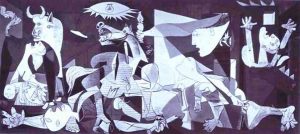
In 1936, Spain declared a civil war between General Franco and the Republicans. Intellectuals from all over Europe are supporting the persecution of phalanxes. But the news is bad. On May 1, 1937, German bombers in Franco’s service launched an inhumane attack on the small northern Basque city of Guernica, killing as many as 1,000 innocent people. Picasso is asked to paint a painting representing Republicans at an exhibition in Paris. So he decides to paint the Guernica atrocity. In two months, it completes the most beautiful painting of the 20th century. Meanwhile, Dora Maar, who documents her work with photographs, gets caught up in it. He goes back and forth between her and Marie-Therese for a long time.
Some time after the outbreak of the second world war, Paris was invaded. Picasso is not well liked by the Nazis because of Guernica. One day the Gestapo will come to your house to search. When a Nazi officer sees a photo of Guernica on the table, he asks: “Did you do this?” Picasso replies: “No, you did it!”
In the spring of 1944, his friend Max Jacob was killed in a Jewish concentration camp where he was taken by the Germans.
On the morning of August 24, 1944, Paris was liberated. After the war, thousands of fans from France, England and America visited to see Picasso. Visitors can be taken to the workshop in small groups.
In the fall of 1945, he moved in with françoise gilot, a painter he had known for two years. Together, they go to the south of France, in what he calls his “landscape.” Picasso has found happiness again. He paints countless portraits of Françoise. He also turned to reinsplaying famous paintings of past masters (Rembrandt, David, Velasquez, Delacroix, El Greco, Poussin, Courbet, Manet).
In 1949, Picasso was asked to make a poster for the Peace Congress in Paris by the Communist Party of which he was a member. His pigeon painting covers the walls in all cities of Europe and becomes a symbol of peace. His second child, born Françoise, is also named Paloma (meaning pigeon in Spanish). He continued his political activities until the Soviet invasion of Hungary in 1956
In Vallauris, where he has lived since 1948, he became interested in ceramics and pottery and produced things that would leave everyone baffled. He paints pictures of his two children. Despite reaching the age of 70, his every move is full of energy and vitality. He plays with his kids, he goes into the sea. He’s having the happiest days of his life. After a while, however, Françoise picasso left. She takes both her children with her. As if all this sadness wasn’t enough, he was overwhelmed by the journalists who watched him like a movie star.
With her new beau Jacqueline Roque, she begins a secluded life in her “La Californie” villa overlooking the sea on the backs of Cannes. He only meets with close friends.
One day in 1958, Picasso-friendly Kahnweiler phoned: “I bought Saint Victoire!” Kahnweiler, who thinks one of Cezanne’s paintings depicting the mountain is at stake, asks: “Which one?” However, Picasso bought the Vauvenargues castle and the 800-hectare northern slope of Mount Saint Victoire, pictured in Cezanne. Now he says to those who ask where he is: “I live in Cezanne.”
He married Jacquelin Roque on March 14, 1961. Cannes settles on a hilltop farm near Mougins, a small town five miles away
On May 1, 1970, his paintings from recent years were exhibited at the Palace of popes in Avignon.
With the help of his devoted friend Jaime Sabarte, he presents almost all youthful works to the Picasso Museum in Barcelona.
On April 8, 1973, news of his death broke. Picasso, who reached the level of immortality while he was still alive, once again left everyone in a state of confusion.
PABLO PICASSO’S WORKS – PAINTINGS – SCULPTURES – DESIGNS – GALLERY – – CLICK TO SEE GALLERY