ANIME – MANGA DRAWING TECHNIQUE
Japanese cartoons are called anime. The word anime is derived from the French word animation.
Let’s take a look at the history of western animation from here. Let’s look at the times when there was no more colorful and sound cinema…. Why do you think the world-famous Betty Boop, who was drawn at Fleischer Studios during this period, had a big head, small eyes, mouth and nose, and long legs even larger than most anime characters? The reason is obvious… Since the Japanese didn’t create this animation, were they short and small-eyed Americans? In addition, let’s pay tribute to a great master who was a real genius in the world of animation, who knew human psychology very well and exhibited it in his works… I mean, Walt Disney… Walt Disney was aware of these facts and used them in animation with great success. Meanwhile, pioneers such as Osamu Tezuka in the emerging art of Japanese animation began to assimilate these drawings and their meanings in western animation and use them in their own works. As a result, people of all races in all countries loved this type of animation and this genre gradually became more and more popular.
Westerners who love this type are not short and small-eyed people. Even though people from the German race, one of the tallest races, are tall and have big eyes, how can you explain that they are among the biggest fans and viewers of anime and manga in the world, especially works drawn in this way like Sailor Moon? One thing to remember is that not only Japanese characters are drawn tall and with big eyes in anime and manga; rather, characters of all races are drawn this way. In response to this strong demand from people all over the world, Japanese artists continued to use this type of character to meet that demand. We also love this style, but we hope people don’t conclude that we are also short and small-eyed because of it.
What is the Place of Anime in World Animation?
Today, many anime are admired around the world and win awards at many prestigious festivals in different countries. After 1958’s The White Snake Enchantress, the first color anime movie, won awards at the Venice, Mexico and Berlin festivals, animes started to have a say around the world, and they continue to increase their success in international competitions every year.
What is the Place of Anime in World Animation?
Although they are not known in Turkey, many anime are watched with admiration worldwide and win awards in many prestigious festivals in different countries. After the first color anime film, The White Snake Enchantress from 1958, won awards in Venice, Mexico and Berlin festivals, anime began to have a say worldwide and continue to increase their success in international competitions every year.
Naturally, western animation companies are not indifferent to the success of anime. Many projects have already been carried out in partnership with western companies for a long time, and as a result, excellent animes emerge. There are many examples of this, such as the French-Japanese co-production Mysterious Cities of Gold. In addition, Disney, which is the representative of western animation, now openly acknowledges the success of anime. For this reason, with the Disney-Tokuma agreement made in 1996, Disney undertook the worldwide distribution and marketing of anime films of Studio Ghibli, the largest representative of Japanese animation. In addition, Disney started to invest in anime films prepared by Studio Ghibli by covering some of the production costs. For example, 10% of the 2.4 billion yen production cost of Studio Ghibli’s Tonari no Yamada-kun (My Neighbors the Yamadas) was paid by Disney.
In addition, Disney once again emphasized the importance it attaches to anime by spending $ 2.4 million for the English dubbing of Princess Mononoke, one of the Studio Ghibli films it distributes in accordance with the agreement.
In addition, Disney once again emphasized the importance it attaches to anime by spending $ 2.4 million for the English dubbing of Princess Mononoke, one of the Studio Ghibli films it distributes in accordance with the agreement.
Anime and Manga are taught and studied as courses in many western universities today.
Today, it is known that many of the most important directors, writers and animators of the western world are fascinated by anime. These people openly express their admiration for anime directors, writers, and animators such as Hayao Miyazaki, Mamoru Oshii, and Katsuhiro Otomo. For example, to give a few examples:
About Hayao Miyazaki, who has been called the “living legend of animation”, Michael O. Johnson, president of Buena Vista, said on a television program:
There are a lot of animators inside Disney who admire Miyazaki….
John Lasseter, director of Pixar Studios’ A Bug’s Life and Toy Story, says: (You can see the full text by clicking here)
When a problem arises at Pixar, if we can’t solve it, we buy one of Miyazaki’s movies and watch it and look for a scene that inspires, and it always works!! We are amazed and inspired. The movie Toy Story owes Mr. Miyazaki a huge debt of gratitude.
Steven Spielberg is said to have said that Lupin III: The Castle of Cagliostro, directed by Hayao Miyazaki, is one of the best adventure movies in the history of cinema and also the one with the best car chase scene.
Barry Cook and Tony Bancroft, the directors of Disney’s Mulan, have this to say:
Miyazaki is like a God to us…
In addition, Gary Trousdale and Kirk Wise, the directors of Disney’s Beauty and the Beast and The Hunchback of Notre Dame, and Glen Keane, the lead animator of Disney’s Ariel, the Beast, Pocahontas and Aladdin, are known to admire Miyazaki’s anime.
Paul Dini, the writer and producer of the animated series Batman and Superman, expresses his admiration for Miyazaki’s anime with the following words:
“Excellent”, “extraordinary” and “a filmmaker who transcends reality and animation”
Rick Sternbach, who has worked in many Star Trek series since 1987, named one of the alien races in Star Trek: The Next Generation Nausicaäns, inspired by Miyazaki’s film Nausicaa of the Valley of Wind.
French artist Jean “Mobius” Giraud, who has planned the stage for world-famous films such as Alien, The Abyss and The Fifth Element, and is the author of comic books such as the world-famous The Aedena Cycle and The Airtight Garage, describes Miyazaki as follows:
He is the brightest flame in children’s thoughts. Miyazaki ennobled this new art, called animation.
Charles Vess, the author of famous comics such as Sandman and Books of Magic, uses many characters created by Miyazaki, such as Totoro and Kiki, in his works.
Akira Kurosawa, one of the world’s greatest directors, puts Miyazaki’s My Neighbor Totoro on the list of the 100 best films of the century and says:
Even though it was animated, I was very impressed. I really loved Nekobus. I cried while watching Kiki’s Delivery Service. All the talent I was looking for for the film industry has moved on to anime. So the film industry is going to have to work really hard. We need to make films like this that attract young people.
The Wachowski brothers, who directed The Matrix, constantly express their admiration for Mamoru Oshii, who has directed and/or written world-famous animes such as Ghost In The Shell, Patlabor, Blood: The Last Vampire, Jin-Roh, Urusei Yatsura. Moreover, it is known that many scenes in The Matrix were actually inspired by Ghost In The Shell. There are many sites that compare these two films and examine scenes that the Matrix took from Ghost In The Shell.
James Cameron, who has written and directed films such as Titanic, Aliens, The Abyss, Rambo II, Terminator, says the following in his letter to Mamoru Oshii
Ghost In The Shell is an impressive work of fiction. For adults, it is the first true animated film that has achieved literary and visual perfection. Its design, the poetry of the visual harmony and the depth of its content place it in a special place in science fiction films. Kudos to Oshii-san – an important visual work.
Frank Miller, who wrote the screenplay for Robocop 2 and 3 movies and the Batman-saga ‘Return of the Dark Knight’ and Daredevil comics, is known to admire Katsuhiro Otomo, who has written and/or directed anime films such as Akira, Robot Carnival, Roujin Z, Spriggan. Frank Miller even named the villain in the movie Robocop III Otomo.
SOME OF THE ANIME DRAWING EXAMPLES
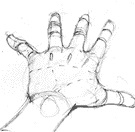
Hand Drawing
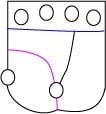 |
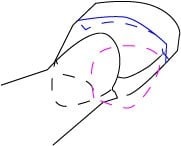
The hand is actually a bit like a shovel… as we sometimes use it for this purpose as well. The lines on your palm show you where your hand is bent and twisted. Above the blue line at the top, you can see the first row of your finger mid-joints. |
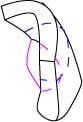 |
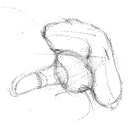
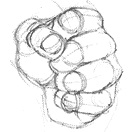
Do not make the hand like a flat triangular prism. The hand bends and follows the contours of the lines in your palm. Look, in the picture you can see that the edge where the thumb is, rotates around the axis of the center of the hand. |
 |
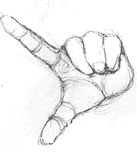
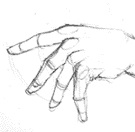
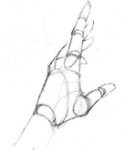
Even when drawing the hand from the back… pay attention to the folds of the lines in your palm. This helps you draw the thumb and other fingers in more natural positions. |
      |
Foot Drawing
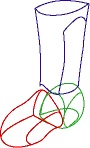 |
Foot: Basic elements Like all the other things you draw, the foot is made up of basic elements. I divide them into 3 sections. 1) A cylinder for the shank bone 2) Half a peanut for the front part 3) A rounded shape for the heel |
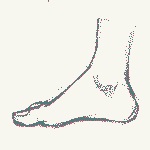 |
Edge view Here, you can more or less see the basic shapes down the foot. The shin bone is coming towards the inside of the ankle. Next, it diverges backward toward the heel and forward toward the toes. Notice that the foot does not sit FLAT on the floor… There is an arch between the toes and the heel. |
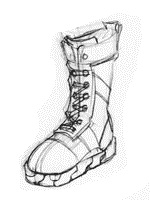 |
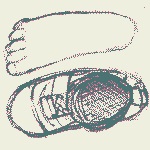
If the shoe fits… Shoes are usually just a cover over the foot shapes. Looking at the shoe pictures will give you an idea of the models. Here I chose a slightly modified US Army Jungleboot. Here you have to make sure that the sole of the shoe is below where the sole of the foot should be. There is a distance of about a quarter of an inch to 4 inches between the sole of the foot and the sole of the shoe. |
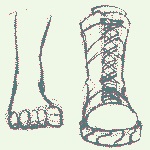 |
If you get stuck… Scratch the foot first. This gives you a better idea of how you should cover the shoe on top of it. |
 |
Triangular part What you need to pay attention to here is that the foot is in the form of a triangular prism, rounded inward and towards the body. The toes are curved, as are the fingers of the hands… The middle finger is usually the longest. |
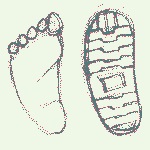 |
Bottom of the foot Okay, this leg is a little wide, but you can see the important parts. Everyone has seen the footprint in the sand. The heel and front parts of the foot are connected to each other by the outer edge of the foot. The arch formed by the foot does not come into contact with the ground. |
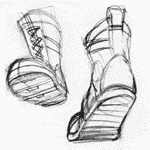 |
Developing different shapes from perspective Once you understand how the foot is formed, you can start to get creative about moving postures. Take a good look at the basic shapes I drew in the first step and try to see those shapes in this drawing on the left… And look to practice very, very, very! |
Expressions
| Angry (okatta) | ||
 |
 |
|
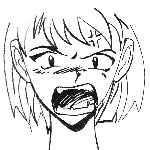
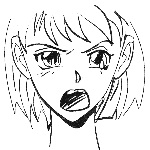
| Really angry: frowning. You make the pupils small and a small “x” in the middle of the moment. Sharp teeth help to express emotion. | Like angry: the pupils have returned to their normal size, but the eyebrows are still frowning. There are no exposed checkers and sharp teeth. | |
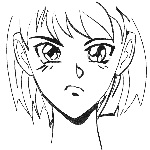 Resentful: disproportionate “u” shaped, with the mouth tilted downward. The eyebrows are still frowning, but not much. Resentful: disproportionate “u” shaped, with the mouth tilted downward. The eyebrows are still frowning, but not much.
|
||
| Sad(kanashii) | ||
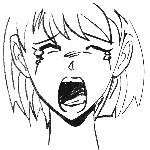 |
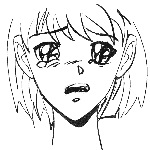 |
|
| Too sad: waAAAAAAAAAHHH!! Eyes tightly closed. The mouth is wide open. Tears of shame and grief flow down your face. Eyebrows up. | Disappointment: Eyebrows up, mouth not too open. There is a little more sparkle in the eyes to give the air of wetness. Tears can still be seen at the corners of the eyes. | |
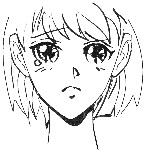 Sad: Eyebrows up… Eyes sparkle with tears. The mouth is downwards in a “u” shape. Sad: Eyebrows up… Eyes sparkle with tears. The mouth is downwards in a “u” shape.
|
||
| Happy (ureshii) | ||
 |
 |
|
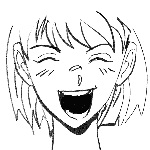
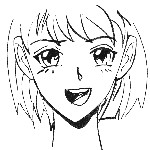
| Joyful: Eyes closed because of the smile. On the cheeks there are traces of blushes of joy. The mouth is side “D” shaped. Eyebrows up. | Cheerful: Eyebrows up. The thin line that follows the top of the eye gives a relaxed expression. The lower eyelids close part of the pupil to show happiness. The mouth is tilted on its side in a “D” shape, but not too large. | |
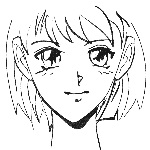 Satisfied: Like cheerful, but the eyes are a little more open. The mouth is like a small curved spring. Satisfied: Like cheerful, but the eyes are a little more open. The mouth is like a small curved spring. |
||
| Others (sono uchi) | ||
 |
 |
|
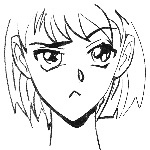
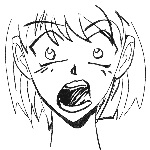
| Thoughtful: My favorite… One of the eyebrows is down and one is up. Mouth inverted like a “v”. Eyes look to the side. | Surprised: eyebrows UP… The eyes are wide, but the pupils are small. The mouth is disproportionately “o”-shaped. | |
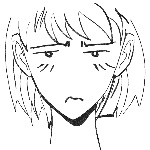
Sick or disgusted: their facial limbs are drawn in the smallest way to add humor. The mouth is under the face in a scrambled way. Eyelids and eyebrows become a straight line. Perhaps I should add a drop of sweat.
Character Design
| Normal Posture | Adventurous/Brave | Sneaky/Sexy |
 |
 |
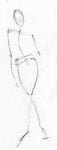 |
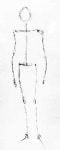
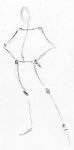
| That’s too much for him. You have no idea if this person is good or bad, happy or sad. It’s a completely neutral stance. | Here’s a character who shows a bit of personality throughout. The posture is wide and the pose is clear; It gives the impression of trust. | The body is “S” shaped. “S” is for sex. The hip bone and shoulders are insinuated with a seductive temperament.. |
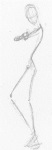
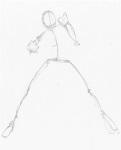
| Mysterious | Combative | Love Scam |
 |
 |
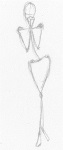 |
| The posture is closed. Arms folded. Back almost turned towards the viewer. | This figure practically shouts, “Come and take it.” Fists are raised in defiance. The stance is wide, as if asserting dominance. | Hands clasped in eager and foolish love. |
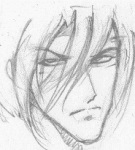
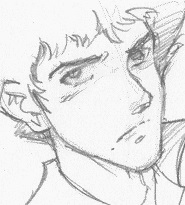
| Bad | Hero | Innocent |
 |
 |
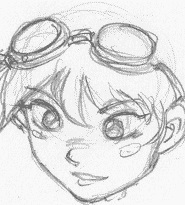 |
| The eyes are narrow and dark. The pupils are smaller, with the more evil characters having almost no pupils. The face has sharp, angular features. | The eyes are larger and rounder. The lines are softer. | The eyes are huge. The eyebrows are not too low. The face is softer and rounder. |
Select Angle
| Bad Angle | |
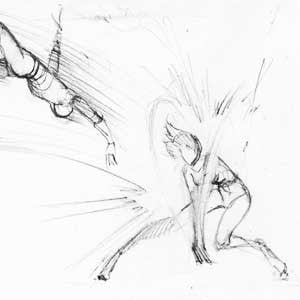 |
This is not to say that the woman’s position is not mobile. It’s just not fair in terms of the representation of the movement. It’s so simple and lifeless. This is the simplest shot that can describe the swing. |
| Better | |
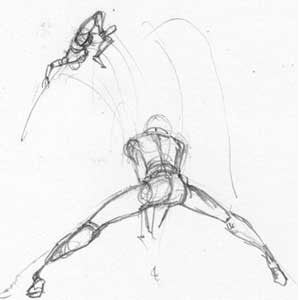 |
This makes sense, as you can tell the target is actually being thrown. This position is more pleasing and leaves the action to the background, sound effects, or speech bubbles… but it could still be better. I would use this shot if the target is going to hit something really important, or if they are going to escape damage by landing on their feet. We need a bit of a close-up to show that this move will render them immobile. |
| The Best | |
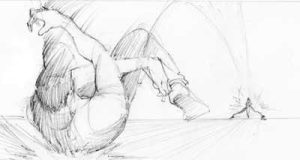 |
|
| Boooooooom! Choosing a frame that shows the moment of fall highlights the integrity of the movement.. in one frame we can see the target being thrown… traveling a long way in the air… and landing very badly. Arms and legs bent! Again… the curvy lines of motion along the path of the swing complete the movement. | |
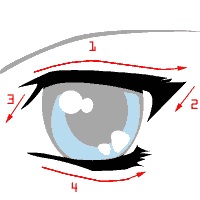
Eye Drawing
|