ABOUT THE LINE
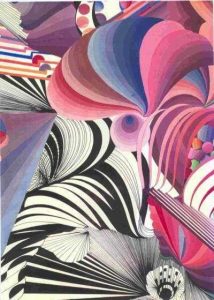
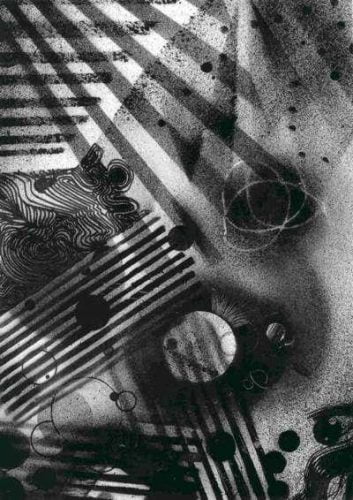
It is a fact that art begins with a line. For this reason, the line is very important and fundamental in art education. The hand performs the line while the eye sees the object. Before, in childhood, the dream world was expressed through the line, while growing up, the reality of the outside world is also revealed by the line in the context of education. The way of seeing the object begins to be reduced to basic elements as the habit of seeing develops over time. For example, the gaze between the eyes of two figures forms a line. Because the line moves the eye not over the thickness, but on the path it has followed.
If we define the line; the extension of a point in the given direction is the line. Regardless of its width and length, if its form creates the effect of a line, we can call it a line. The line is the concept that arises from the continuous movement of the point. Without going to the depth and width of the distance, the points that go in the direction of length are integrity. It is also considered a limit setter.
When we look at nature, we come across various linear structures. Wood textures, tree branches, leeks, zebras etc. Man-made materials; iron bars, cloth, burlap etc. as…
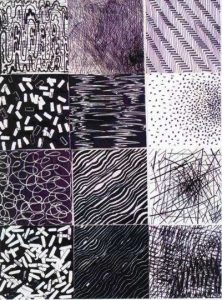
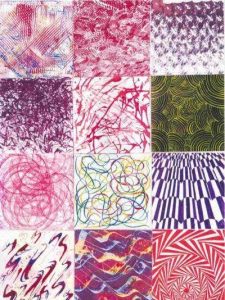
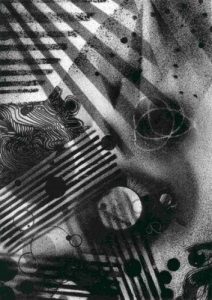
In basic art education, the different structure of the line, its relationship with each other, and different interpretations with different materials are in question. The difference arising from the shapes of the lines and their relationship with each other leaves different effects on us. Movement, stillness, depth, etc. as.
We can examine the character of the line in two directions:
* In terms of the shape of the line,
* In terms of the position of the line.
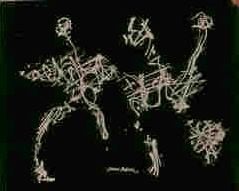
The character of the line in terms of its form; Consider a straight line, a wavy curve, and a broken line. If we assume for a moment that they are read like writing, and try to read them, they are read correctly, continuously and uninterruptedly. Although there is movement in the wavy curve, it is completely different from the first. So here the reading is uninterrupted, but not ceaseless. Broken line reading is more tiring and longer for the eye.
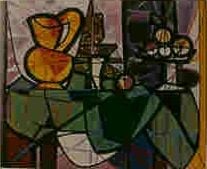
The character of the line in terms of its position; If we present the same lines to the viewer not horizontally, but obliquely or vertically, we get different effects. The character of a horizontal line is immobility and static. It is particularly dynamic if it is correct in the vertical position. According to the degree of inclination of the oblique line, it contains a full series of characters between inactivity and dynamism. The character of the truth is continuity and smoothness, and in addition, dynamism or dynamism, depending on the situation. As for the wavy curve, if it is smooth and horizontal, it has a static character. If it is irregular and horizontal, it is dynamic. Smooth and irregular is dynamic if arranged vertically. When arranged obliquely, it is always dynamic. However, as it approaches horizontal, it also approaches static. The dynamism and immobility character of the broken line is similar to the wavy curve. Direction is an important element in design in direction. Broken line hardness, wavy, curved lines evoke softness. Lines that are related to each other, gradually thickening-thinning, getting denser-sparse, growing-shrinking with certain systems, give the surface an optical movement.
Some principles that can bring output in linear expression:
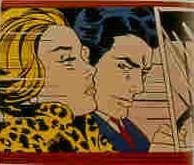
1- Before the line: The vague appearance of the light behind a smoke screen,
2- Spreading the light leaking from the linear gap as a clear beam of lines,
3 – Light beam: The indefinite spread of the sun’s rays emanating from a source,
4- Starting and ending points are certain lines, (line segments)
5- The rays, which are precise at the point of departure, become vague and diffuse as they move away in the dark,
6- The intersection of two or more independent lines,
7- A line dependent on at least one point,
8- Dependent lines (lines surrounding the forms),
9- Dependent lines (lines that determine the internal structures of forms),
10- Indirect lines,
11- Linear structure formed by the points of intersection, contact, and rupture with the directional influences provided by the deviations carried by a line,
12- Linear length values; structure formed by different equally spaced parallel lines,
13- Linear length variations: The structure formed by equally spaced parallel lines of different lengths on a main line,
14- Free length variations on curved parallel lines (different intervals)
15- The order formed by parallel lines with increasing intervals,
16- The order formed by the determinant dash segments following the structure of the form
17- The order formed by short, straight and equivalent lines with free direction,
18- Small lines expressing the superficial appearance of an object,
19- Linear thickness series,
20- Variations of various lengths, thicknesses and intermittent lines,
21- Stopping a line in one direction by cutting it with a line in the other direction,
22- Linear form: Curves, arcs, breaks and the tension they create,
23- Vertical and horizontal lines, spiral lines etc.
24- Free,
25- Filling and scanning with a certain line,
26- Space and depth with a line,
27- Line – texture,
28- Tone with lines,
29- Freelance work on the same fund with different lines,
30- Evenly spaced, parallel lines of the same thickness,
31- Straight lines with different spacing and different thickness,
32- Round lines,
33- Intersecting lines, (straight, curved)
34- Intersecting circular lines,
35- Thick-thin, frequent-sparse lines that intersect each other,
36- Bundles of dashes intersecting each other,
37- Lines surrounding the forms
38- Lines that determine the internal structures of forms
39- The order formed by lines of different lengths and thicknesses,
40- Line variations in various lengths, thicknesses and spacings
41- Linear form; curves, arcs, breaks and their order,
42- The order formed by straight and curved contrasts on a continuous line,
43- The order formed by the breaking of parallel and straight lines and changing direction,
44- Centrifugal and centripetal lines,
45- Lines supporting a main line,
46- Spiral lines.
Many more systems can be added to these systems.