Vincent Van Gogh (1853 -1890) Life and Works Of Art
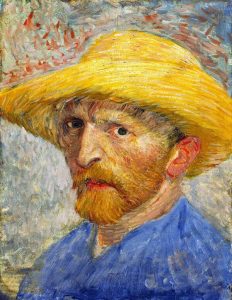
Vincent Van Gogh was born in 1853 in the town of Zundert, in the Dutch province of northern Brabant (Netherlands). His father was a priest. Van Gogh, one of the most tragic artists of the 19th century, lived in constant depression and struggled with the thoughts that it was useless and the desire to do something, to find a way out. He has suffered, experienced unhappiness, despite his restlessness and loneliness, he wanted to arouse joy and joy with his paintings, tried to turn pain into joy, sadness into joy and loneliness into togetherness.
He was influenced by the loneliness, sadness and pain of people and reflected these in his paintings. He was interested in those who suffered. He feels incompatible with the world he lives in. The main source of his melancholy and unhappiness is his loneliness. His doubts that he would not be able to achieve what he wanted to achieve, his tragic fate with his illness and his feelings of loneliness, resulted in him ending his life.
Van Gogh saw himself humiliated and alienated from love. In the letter he wrote to his brother Teo, he says that his uselessness is not in his own hands, that he was locked in a cage as a result of the series of events drawn by fate, that he wanted to do something, but could not find a way. Later, he decides that his job to overcome all these is painting, and he dedicates himself to it with great enthusiasm.
“It is better to feel pain than to laugh, because pain purifies one’s heart. It is not known what it is that locks people alive and builds walls around them, but still the existence of some walls, wire fences, iron bars is felt. Is all this a delusion, a dream? I don’t think so. And One asks oneself, My God, is this a long-term, permanent and universal eternity?”
In his early charcoal works, he dealt with miners and peasants, dealt with subjects such as potato piles and looms, and painted gloomy skies
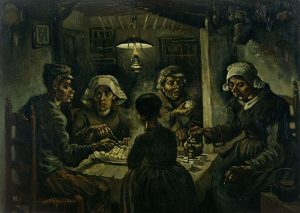
and dark landscapes and depressing landscapes. The Potato Eaters painting symbolizes this bleak and depressing period (Vincent Van Gogh Museum, Amsterdam). The 1885 painting focuses on everyday life in the interior. Workers have been shown eating potatoes they have planted by sharing. The only source of light is a lamp hanging from above. The light of the lamp illuminates the potatoes. The same colors and tones prevail throughout the picture. Dark shades of green and brown. He was trying to get the dusty color of the potato. The color that dominated the whole picture was the color of wild potatoes. The gloomy and dark appearance of the painting and the faces of the people, the poverty create a melancholic atmosphere. Observing such people, Van Gogh also knew what poverty meant. In a letter he wrote to his brother during this period, “If it continues like this, I will not reach my goal. If I hadn’t been hungry for so long, my body would have been stronger. But each time I had to choose one of the options of working less or going hungry, I always preferred to go hungry. How can a person withstand this? I can see the impact of hunger in my paintings so much that I worry about my future.”
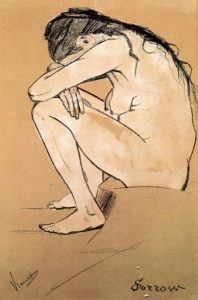
The 1882 lithograph Sadness depicts a sitting (Vincent Van Gogh Museum, Amsterdam). The woman’s head was bent against her knee and she was caught between her arms. Her dark long hair falls down from her bare back. Hair with skin color. The outline of the figure is clarified. His face between his arms is not visible, but he is most likely crying or expressing sadness. Left alone, he has a desperate situation. With his sorrows, he is all alone, he is pushed. We are witnessing a poignant expression of grief. The woman here is Sien, an alcoholic, pregnant and prostitute with whom Van Gogh lives. This painting also has a charcoal drawing.
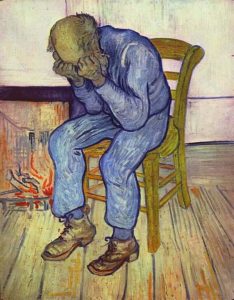
Van Gogh’s 1890 painting At Eternity’s Gate – 1890 also depicts a person in grief (Rijksmuseum Kröller Muller, Otterlo). The picture depicts pain of an old man in blue pants and a shirt sitting on a chair. The old man covered his face with his fist-making hands, rested his elbows on his legs, and leaned forward. Her eyes and face are not visible, but she too is crying and devastated.
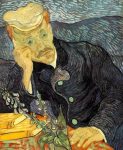
In the same year, in his painting Portrait of Doctor Gachet -1890- a man sitting on the table with his elbow is seen (Musee du Jeu de Pavme, Paris). The fist of the white helmeted figure supports his head on his cheek. Van Gogh notes that the thoughtful and mournful looking Doctor Gachet seemed as sick to him as he was angry. The face of the figure is dominated by melancholy, sadness, despair and despair. This sadness pervades the picture. All colors and lines fit this melancholic atmosphere. The lines of the figure follow the gloomy appearance and reveal this emotional mood. The navy blue coat on it and the dark blue color of the background and the pallor of the face reinforce the expression.
“” In the painting, van Gogh was looking for a way to cut himself off from life. There is no second painter who reflects his enthusiasm, storms, sorrows and extreme feelings in his portraits. A Van Gogh who constantly reckons with himself, who is always unsure of himself, who is constantly crushed and sensitive because of looking at someone else’s hand, but who does not give up the path he is going and believes in, who is not understood by those around him. With his pain, his unhappiness, his restlessness, his searches, his ambition, his enthusiasm, his endless loneliness, his hunger for love, his poverty, his respect for what he does, all the works he has packed into his short life, the letters he wrote to his brother Theo, his illness, his crises, his choices between a bowl of soup and a paint tube are the ones who made him Van Gogh.”Most of the time I can’t believe I’m 30 years old. I feel a lot older. When I think that most of those who know me the most regard me as ‘rante’ and believe that if things don’t change, maybe they will be right, I feel gutted, as if this has already happened.“
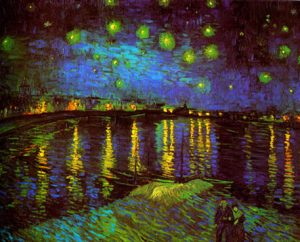
Starry Night Over the Rhone -1888, the depiction of the starry night is dazzling. Luminous stars, artificial lights hitting the sea from the shore, and dark blue and blue tones spread throughout the picture. A couple is seen walking in the foreground. The male of the couples seen here and in other paintings is depicted as having red hair. The painter, who was alone all his life, always drew his wife, whom he could never find in real life, next to him in his paintings. The figures are very small in the landscape and face the viewer. In one of his letters, he wrote, “The problem of transferring the night landscapes and the features of the night environment to the canvas in the true darkness of the night and on the spot, besieges me from all sides“. It indicates that death is a means to go to the stars in the sky. He thought that the stars attained by death might be attainable. The night is dark, it is fear, it is death, it is sleep, it is loneliness, it is sadness.